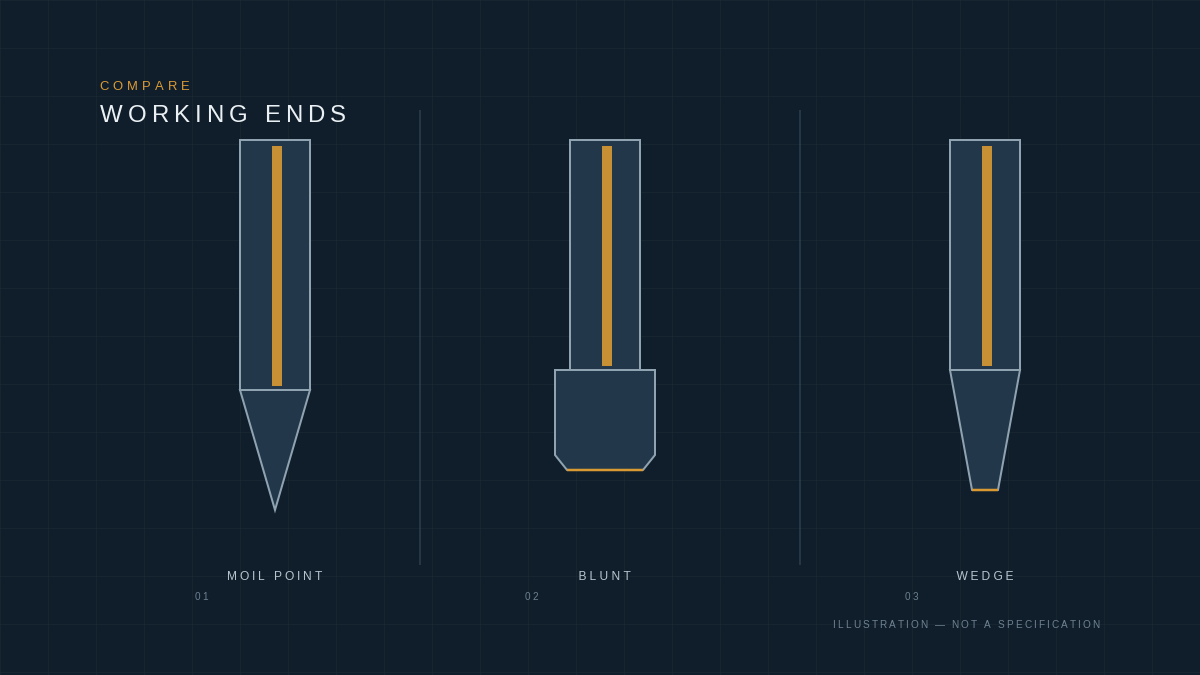
The three most common breaker chisel names describe a shape at the working end. They are a useful starting point for a conversation — not a guarantee of performance in a given material. What actually works depends on the breaker, the tool dimensions, the retainer arrangement, the material and how the machine is used.
Here is what separates the three profiles, and where a buyer should stop guessing and ask for confirmation.
The working end is the difference
A hydraulic breaker chisel is a consumable tool that transfers impact energy from the breaker piston into the material. The shank end fits the breaker; the working end meets the job.
Moil point, blunt and wedge describe the working end:
- Moil point: a point.
- Blunt: a broad, flat face.
- Wedge: an edge formed by two angled faces.
Everything else — tool diameter, overall length, shank profile, retainer type — has to match the breaker regardless of which profile you choose.
Moil point chisels
The moil point tapers to a single point. The small contact area concentrates force at the tip, which is why pointed tools are commonly requested where the work starts with penetration: breaking out concrete, opening a seam, or working in a confined spot.
Typical requests include general demolition, trenching and first-pass breaking. In practice, the point is also used to start a break before a wider tool is brought in. That is a working method, not a rule — the result still depends on the material, the breaker energy and the operator.
A pointed tool is not automatically the right answer. In some materials a point can penetrate deeply instead of breaking the material efficiently, or wear quickly at the tip. If the job is mostly sizing already-broken material, a flat or wedge tool may be worth discussing.
Blunt chisels (blunt tools)
A blunt chisel finishes in a flat face. The face presents a broader contact area than a point, which is why blunt tools are often requested for secondary breaking, sizing and clean-up work.
Face design varies. Some tools are flat across the full width, some are slightly relieved, and corner treatment can differ. Those details are worth confirming from the existing tool or the supplier’s drawing, because “blunt” alone does not define the face geometry.
Blunt tools are commonly used where a point would penetrate too deeply or where a broader face suits the material. Again, this is application guidance, not a performance promise: a flat face in the wrong material can simply stall or wear unevenly.
Wedge chisels
A wedge chisel has a cutting edge formed by two angled faces. It is frequently associated with rock and asphalt work, where a narrower cutting profile is preferred over a point or a broad flat face.
The edge angle and edge width are part of the tool design. They are not universal, and a “wedge” from one supplier is not necessarily the same profile as a wedge from another. If the edge shape matters to your application, confirm it from a photo, a drawing or the existing tool.
Wedges can be used to split or lift material depending on conditions. How well that works varies with the material, the breaker and technique. A wedge is not a substitute for a purpose-designed tool in every application.
Quick comparison
| Profile | Working end | Commonly requested for | Confirm before ordering |
|---|---|---|---|
| Moil point | Single point | Penetration, general breaking, demolition, trenching | Point profile, tip condition, shank fit |
| Blunt | Broad flat face | Secondary breaking, sizing, clean-up | Face width, corner treatment, shank fit |
| Wedge | Angled cutting edge | Rock and asphalt work where an edge is preferred | Edge angle and width, shank fit |
The “confirm” column is the important one. None of these profiles can be matched from the name alone.
The other two patterns
The RocMotive range also includes conical slotted and forged square chisels. Their names describe more than the tip:
- Conical slotted combines a conical working end with a slotted shank. The slot interacts with the breaker’s retainer, so the slot dimensions and position are part of the fit.
- Forged square describes a square-profile working end and a forged body. The square profile still has to match the breaker’s tool holder and the application.
For both, the shank and retainer details are as decisive as the working end.
What decides more than the profile
Two buyers can choose the same profile and get different results because the rest of the tool and the job differ. Before settling on a profile, confirm:
- Breaker brand and model. This drives the shank interface and the recommended tool size.
- Tool diameter and overall length. Measured, not guessed — and measured at the points the supplier defines.
- Shank and retainer arrangement. Pin, plate, slot or notch; a photo removes most of the ambiguity.
- Material and working conditions. Concrete, rock, asphalt, slag or mixed demolition debris each behave differently.
- Working method. First-pass breaking, secondary breaking and clean-up are different jobs.
If any of these is unknown, say so. A supplier can work with partial information if they know which parts are missing.
How to choose without guessing
Start from what you already have. If the current tool works for the job, identify it and replace like for like. If it does not, describe why: too slow, wearing at the tip, stalling, or not breaking the material the way you need. That description is more useful than a profile name alone.
Then ask the supplier to confirm the recommendation against your breaker and tool details. A good answer explains what was matched and what still needs checking — it does not just promise that a tool will fit.
Read how to identify the correct hydraulic breaker chisel for the measurement and photo checklist, or review the five chisel patterns and send your breaker details for a compatibility review.